Quote list0
Your product list is empty!


Incapacitance Tester Librae (Weight Bearing)

Product Code:47882/47883/47885

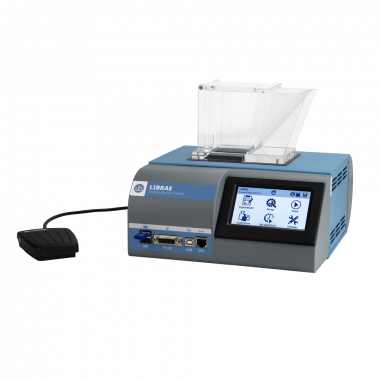
Measures the weight distribution difference between an injured and unaffected hind paw of a mouse or rat. For the assessment of spontaneous pain in osteoarthritis, bone cancer, nerve injury and post-operative pain studies. Automatic operation reduces operator bias, optimizes repeatability and saves time. Easy to set up. Data visualization to monitor trends. Fast and easy cleaning procedures.

Model
Choose a model to get a quote...
An extended warranty can be added for most Ugo Basile products. You can find this information in the ordering information section of each product.
To learn more about the extended warranty, CLICK HERE

Background

Also called “Incapacitance Tester” or “Static Weight Bearing”, it is the classic method to assess unilateral pain (especially joint pain, but also neuropathic pain, etc.), as when the animal stands on the force sensors (one per hind paw), it makes a natural adjustment to the degree of pain, by adapting weight distribution on both rear paws.

Shifts in pain distribution between limbs serve as indicators of pain severity, offering a quantitative and simple method to quantify the extent of weight distribution imbalances caused by pain. Weight bearing devices can also be used in longitudinal studies to understand pain progression and effectiveness of treatments, to screen potential drug candidates as well as in translational studies.

Automated, efficient, accurate

  • Automation of the measurement process using AutoStart, a unique feature that identifies immobility windows to optimise test repeatability and save operator time.
  • Option to switch to manual mode with the included foot pedal for hands free operation.
  • Quick calibration of high quality, precision force sensors (0.1g resolution) using the reference weight supplied.
  • Maximum weight 500 gr.
  • Quick, seamless management of settings and data using large, bright, colour touch screen.
  • Visualization of test data as left/right weight histograms and scatter charts displaying trend data.
  • Recorded parameters include average paw weight, Standard Deviation, Left/Right ratio and more.
  • Data is saved in universal .csv format for spreadsheets including Microsoft Excel. Easy transfer of data using supplied USB key. 
  • No screws or protruding parts that can cause interference with the rodents and possibly compromise experiment results. 
  • Fast cleaning of foot pads (within seconds) because they are conveniently attached magnetically for easy removal.


Features

Benefits

Measure hind paw weight distribution

The most widely used method for weight bearing (>1,500 citations) is now updated and equipped with the latest technologies by Ugo Basile.

Autostart is a unique feature

Automate the measurement process by identifying immobility windows. 

Touch screen and USB data storage

Let scientists setting, controlling and managing instrument data quickly and seamlessly. Through a few, intuitive buttons, one can reach all the functionalities. The included USB key stores all data for optimal portability (average paw weight, Standard Deviation, Left/Right ratio, etc.). The Left/Right weight histograms and scatter charts display on line the experiment output for an immediate visual control, graphically effective and easy to follow during the test.

Reliable and easy to collect results:, software included

High quality force sensors (0.1g resolution) are easily calibrated with the provided reference weight and show no screws or other parts potentially interfering with the animal, for maximum experiment repeatability. After each test the result can be stored or discarded and data can be transferred from the instrument to a PC for MS Excel.

At the end of the experiment the foot pads can be cleaned in a few seconds, being magnetically attached to the base.

General

Command input and read-out

4,3 inches touch-screen (Resistive)

Power Requirements

Universal input 100-240 VAC, 50-60Hz, 15W max

Sound Level

Negligible

Operating Environment

10°C to 40°C; 5% to 95% RH (non-condensing)

Operation

Animal weight (per paw)

From 20g to 2200g
Precision From 0.05% to 0.1%
Measurement time From 1s to 360s
Measurement starting mode Manual and Automatic
Calibration Automatic

Start

Start button, Pedal Switch, or Autostart

Stop

Stop button, Pedal Switch, or Elapsed Timeout

Data Export

.csv format, from USB key (provided)

TTL I/O Start, Stop, Mode


Physical Librae Incapacitance tester

47880-001

25 cm x 25 cm x 13 cm

Packaging dimension:

45 cm x 34 cm x 26 cm

Weight:

2.5 Kg


Physical Restrainers

Model SKU

Length Internal Base

Length Top Height Width Animal Range

47880-003

34 mm 64 mm 55 mm 40 mm mouse

47880-002

53 mm

124 mm 89 mm 64 mm rat up to 200 gr
47880-004 54-78 mm 123-147 mm 89 mm 64 mm rat up to 250 gr
47880-007 107 mm 189 mm 103 mm 80 mm rat up to 350 gr
47880-008 117 mm 217 mm 123 mm 100 mm rat up to 500 gr


Warranty 

Warranty Librae is covered by a 12-month warranty + 12 months after product registration
UB-Care Additional UB-Care can be added for other 12 or 24 months (see ordering informations)


Weight distribution is especially important in conditions where musculoskeletal and neurological systems are affected. The most typical is Osteoarthritis, a degenerative joint disease where joint cartilage breaks down. It is broadly used also in rheumatoid arthritis, where the autoimmune mechanism ends up with joint inflammation and relative pain.

The altered sensation typical of neuropathic pain, especially when unilateral nerve injury models are used, can lead to abnormal weight distribution, quantifying how neuropathic pain influences gait and balance. The same applies to diabetic neuropathies.

Also, stroke can lead to altered weight distribution as a result of the associated motor impairments and adaptations to their motor deficits, resulting in abnormal weight distribution. Recovery of weight distribution is tracked during injury rehabilitation studies.

In summary, weight distribution measurement is a valuable tool in pharmacology, phenotyping, validation of animal models, translational studies, relatively to a broad number of treatments and diseases.

47882 Librae for Rats - What's in the box?

47880-001 Librae Incapacitance tester, max load 2.2Kg. per paw, resolution 0.1 g, USB data export, self calibration and autostart modes, no restrainer, pedal switch, calibration weight, Included
47880-002 Librae Incapacitance tester restrainer for rat up to 200 gr in clear perspex
47880-321 Librae Incapacitance tester magnetic pads (pair left + right)

47883 Librae for Mice - What's in the box?

47880-001 Librae Incapacitance tester, max load 2.2Kg. per paw, resolution 0.1 g, USB data export, self calibration and autostart modes, no restrainer, pedal switch, calibration weight, Included
47880-003 Librae Incapacitance tester restrainer for mouse in clear perspex
47880-321 Librae Incapacitance tester magnetic pads (pair left + right)

47885 Librae Combo for Mice and Rats - What's in the box?

47880-001 Librae Incapacitance tester, max load 2.2Kg. per paw, resolution 0.1 g, USB data export, self calibration and autostart modes, no restrainer, pedal switch, calibration weight, Included
47880-002 Librae Incapacitance tester restrainer for rat uo to 200 gr in clear perspex
47880-003 Librae Incapacitance tester restrainer for mouse in clear perspex
47880-321 Librae Incapacitance tester magnetic pads (pair left + right)
Optional Items
47880-002 Librae Incapacitance tester restrainer for rat uo to 200 gr in clear perspex
47880-003 Librae Incapacitance tester restrainer for mouse in clear perspex
47880-004 Librae Incapacitance tester adjustable restrainer for rat up to 250 gr in clear perspex
47880-007 Librae Incapacitance tester restrainer for rat up to 350 gr in clear perspex, including 2 magnetic pads
47880-008 Librae Incapacitance tester restrainer for rat up to 500 gr in clear perspex, including 2 magnetic pads
47880-323 Reducer for small animal to be used only with Librae Incapacitance tester restrainer 47880-003
47882-UBC12 UB-Care 12 Additional hardware warranty Librae for Rats
47882-UBC24 UB-Care 24 Additional hardware warranty Librae for Rats
47883-UBC12 UB-Care 12 Additional hardware warranty Librae for Mice
47883-UBC24 UB-Care 24 Additional hardware warranty Librae forMice
47885-UBC12 UB-Care 12 Additional hardware warranty Librae for Mice and Rats
47885-UBC24 UB-Care 24 Additional hardware warranty Librae for Mice and Rats
Back to: Pain and Inflammation

Research insights

Preclinical research in pain and inflammation

Pain affects an estimated 20% of adults worldwide, with millions of new chronic pain cases diagnosed every year. Yet, it remains insufficiently addressed as a major public health issue. Recognizing pain as a complex condition influenced by biological, social and environmental factors is essential to improve research, prevention, treatment and health policies.

Developing safer and more effective pain management strategies requires a deeper understanding of the biological mechanisms underlying pain and inflammation. In this context, preclinical research plays a fundamental role in identifying therapeutic targets, evaluating novel treatments and generating evidence to support translation into clinical practice.

Most used paradigms for pain and inflammation research

Pain and inflammation research uses a combination of evoked and spontaneous paradigms to assess nociception, hypersensitivity, inflammatory responses and pain-related impairment in rodents. Evoked thermal paradigms include plantar stimulation, tail flick, hot/cold plate testing, thermal place preference and thermal gradient assessment, which are used to investigate heat sensitivity, cold sensitivity, thermal hyperalgesia, allodinya and thermal preference or avoidance.

Mechanical paradigms include dynamic plantar stimulation, electronic or manual Von Frey testing, paw pressure testing and direct joint pressure application, supporting the assessment of mechanical allodynia, hyperalgesia and joint hypersensitivity. Spontaneous pain paradigms include weight-bearing asymmetry, postural imbalance, vertical activity and gait or locomotor changes, which are particularly relevant in arthritis, neuropathic pain, bone cancer pain, post-surgical pain and inflammatory models.

Inflammation can also be evaluated as a dedicated endpoint through paw volume and oedema measurement, allowing researchers to quantify experimentally induced swelling and pharmacological treatment effects.

Specific pain conditions like the ones involving the Trigeminal nerve are assessed by dedicated devices for thermal and mechanical stimulation of the animal vibrissae area, during the Orofacial Test.

Key behavioral readouts in pain assessment

Pain and inflammation studies rely on behavioural readouts that quantify nociceptive thresholds, hypersensitivity, inflammatory responses and spontaneous pain-related behaviour. Key measured parameters include paw withdrawal latency after thermal stimulation, tail flick latency, vocalization, jumping, mechanical withdrawal threshold, force threshold, paw volume, oedema, hind paw weight distribution, thermal preference or avoidance, time spent in specific temperature zones, postural asymmetry and pain-related changes in locomotion or vertical activity.

These readouts help researchers assess hyperalgesia, allodynia, inflammatory pain, joint pain, neuropathic pain, post-surgical pain and treatment effects across different rodent models. By combining evoked responses with spontaneous behavioural endpoints, preclinical pain research can capture both stimulus-induced sensitivity and more naturalistic pain-related impairment. Ugo Basile’s pain portfolio includes instruments for thermal, mechanical, inflammatory and spontaneous pain assessment, including Plantar Test, Dynamic Plantar Aesthesiometer, Hot/Cold Plate, Electronic Von Frey, Plethysmometer, Librae Incapacitance Tester and Climbing Test.

Ugo Basile instruments for pain and inflammation research

Since 1963, Ugo Basile has supported pain and inflammation research with instruments designed to measure nociceptive thresholds, hypersensitivity, inflammatory responses and spontaneous pain-related behaviour in rodents.

Ugo Basile offers a complete portfolio of instruments for preclinical pain and inflammation research, covering thermal, mechanical, inflammatory and spontaneous pain-related endpoints.

Ugo Basile devices for thermal stimulation

The Plantar Test is used for thermal hyperalgesia studies through radiant heat stimulation of the hind paw and automatic paw-withdrawal detection. It is the gold standard for Thermal Hyperalgesia tests in unrestrained animals. The Tail Flick measures nociceptive thresholds to infrared heat stimulation of the tail and is especially suited to rapid, reflex-based analgesic screening with possibility to run repeated tests thanks to the lack of learning being the tail flick a reflexive response. The Hot/Cold Plate supports hot and cold sensitivity studies, including constant temperature, ramping and complex temperature protocols, while the Thermal Place Preference and Thermal Gradient Ring allow researchers to evaluate thermal preference and avoidance in freely moving animals. Both systems involve a cognitive component and in fact repeated tests on the same animal are subject to hyper- or hypo- responses due to previous test experience.

Orofacial Stimulation measures hypersensitivity to thermal (hot and cold) and/or mechanical stimulation of the orofacial area in rats (mouse adaptor available) and is used for research into a wide range of pain conditions involving the trigeminal nerve with no need to cut vibrissae.

Ugo Basile devices for evoked mechanical stimulation

For mechanical sensitivity, the Dynamic Plantar Aesthesiometer provides automated force application and paw-withdrawal scoring for mechanical allodynia studies, while the Electronic Von Frey and Von Frey Filaments support mechanical threshold assessment across different force ranges. The PAM – Pressure Application Measurement system is designed for joint pain and arthritis models, enabling direct quantifiable stimulation of rodent joints. However the PAM can also be used with specific applicators for other parts of the body from the paws to the back and spinal chord, etc. Analgesy-Meter is typically used for inflammatory conditions to measure to measure mechanical sensitivity and pain threshold of pressure applied on mic or rat paw for basic or applied research or phenotyping.

Ugo Basile spontaneous pain apparatus

The Climbing Test adds a vertical activity endpoint for spontaneous pain, motor function and activity-related studies. Librae Incapacitance Tester assesses hind paw weight distribution as an objective measure of spontaneous pain. Plethysmometer measures paw volume and oedema.

Frequently Asked Questions

What instruments are used to measure pain in rodents?

Rodent pain can be assessed using different instruments depending on the type of pain response being studied. Thermal pain is commonly measured with plantar stimulation systems, tail flick meters, hot/cold plates, thermal place preference systems and thermal gradient paradigms. Mechanical sensitivity is assessed with dynamic plantar aesthesiometers, electronic Von Frey devices, manual Von Frey filaments, paw pressure systems and joint pressure tools. Spontaneous pain and inflammation can be evaluated through weight-bearing asymmetry, paw volume measurement, gait analysis and activity-based readouts.