Quote list0
Your product list is empty!

Animal
Mouse
Videotracking
Traditional, Infrared

Operant Fear Conditioning (OFC)

Product Code:49603

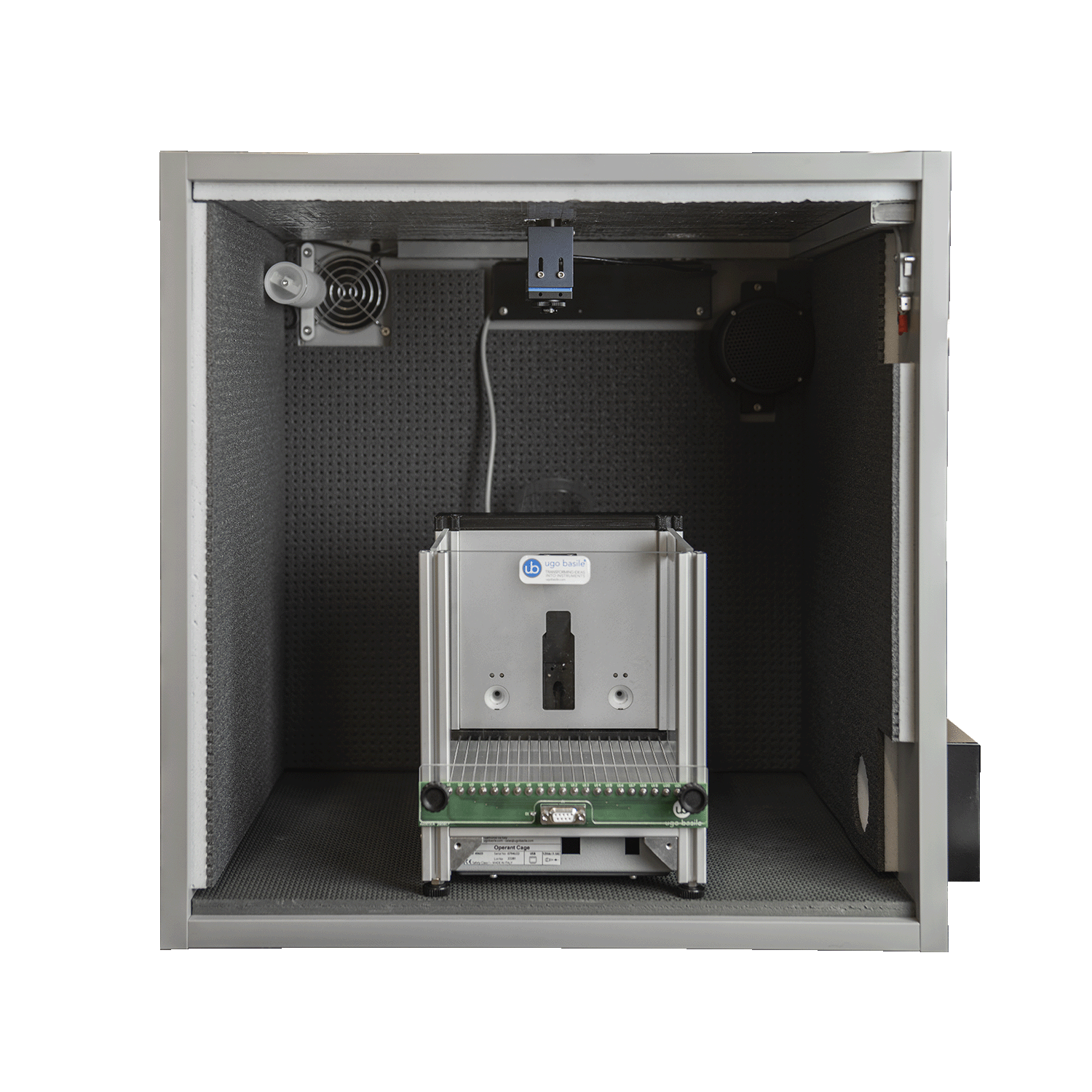
The Operant Fear Conditioning Cage couples a classic skinner box with sound and light cues for complex experiments, as well as standard operant tests and fear conditioning protocols.

Model
System Component 2
Optional Please see "Ordering Information" for more details. For special requests use "Notes and Special Requests" section on the quote confirmation page.
An extended warranty can be added for most Ugo Basile products. You can find this information in the ordering information section of each product.
To learn more about the extended warranty, CLICK HERE

Dual purpose systems to be used for Operant or Fear Conditioning experiments

A standard Fear Conditioning cage has been modified adding an operant wall with 1 pellet dispenser, 2 nose pokes, a house light and 2 cue lights above the nose pokes. The operant wall can be hidden by a removable plastic wall to use the cage as a standard Fear Conditioning.

Protocols, results and analyses are managed by Any-maze, through which virtually all Operant tests can be programmed:

  • Fixed Ratio
  • Variable Ratio
  • Progressive Ratio
  • Fixed Interval
  • Variable Interval
  • Extinction
  • Delayed Reinforcement and Discounting
  • Matching law
  • Reversal learning
  • Timeout

Also for Fear Conditioning the most common procedures and many more can be run via Any-maze:

  • Cued and Contextual
  • Trace
  • Extinction
  • Observational


Feature and benefits  
The same cage includes both reward and shock floor

Both Operant and Fear Conditioning experiments can be run in the same system

The isolation cubicle includes all electronics, shock and lights One isolation cubicle can be used for multiple types of experiments without any additional module
Multiple cages can be connected to 1 PC via USB High throughput experiments can be run
Procedures are created by a fully graphical interface No need for coding. Fast learning curve even for non IT-personnel
Operation
Read-Out USB to PC through AnyMaze, TTL I/O

General 

Shock

Constant current

Shock Intensity

from 0.1 to 3mA, in 0.1mA steps

Shock Duration

Duration: from 0.5 to 60 seconds

Cue Light

Dimmable visible 6500K

Pellet Dispenser

One with manger and reward detection

Nose Poke Two with detection and no odor delivery
Nose Poke LEDs Two, one yellow and one blue

Power 

100-240 VAC, 50/60 Hz, 60W max

Operating Temperature

10°C to 40°C; 5% to 95% RH (non-condensing)

Context

One set for Fear Conditioning tests
One set for operant experiments

Physical

Dimension Outer Size

Internal size with grid

17,5(d)x17,5(w)x16,5(h)cm

Internal size with floor 17,5(d)x17,5(w)x16,5(h)cm
External size (with Pellet Dispenser) 36,3(w)x20(d)x25,7(h)cm
Shipping dimensions

36x55x45xm

Weight

6Kg

Shipping Weight

10.5Kg

Warranty

Warranty Operant Fear Conditioning is covered by a 12-month warranty + 12 after product registration


The Operant Fear Conditioning system can be essentially used in three ways:


  1. As an Operant system: Operant experiments are fully programmable with the ANY-Maze software, and protocols ranging from Fixed or Variable Ratio, Fixed or Variable Schedule, Progressive Schedule, Delay Discounting, Extinction, etc.
  2. As a Fear Conditioning: The operant wall can be covered by a provided plastic wall, so that Fear Conditioning experiments can be performed in all their different declinations, taking advantage of the high accuracy of the Any-Maze freezing detection algorithm.
  3. As Avoidance and Conflict Tests (reward vs shock): The Operant Wall and the Fear Conditioning set-up can also be used in combination for Avoidance Experiments, for example by partially covering the grid floor with a small plastic platform and measuring the motivation of rodents to leave the platform and get the pellet, in spite of the shock risk (Bavo-Rivera et al., 2014, The Journal of Neuroscience).
Operant Fear Conditioning - What's in the box
49603 Operant Cage & Fear Conditioning cage with 2 nose pokes, minimum 2x2 coloured lights, white light (to be used as conditioning cue or omission cue), pellet dispenser with measuring feeder and electrified grid. Context and floor also available for free on request
49104 Pellet dispenser with interchangeable accessories for rat and mouse
Additional items (for Fear Conditioning System complete set-up)
46001

Fear-Conditioning Unit, including Isolation Cubicle 46000-596 (inside dimensions 39(d)x47(w)x49(h)cm), dual visible/I.R. light 46000-325, speaker 46000-165, controller on-board 46000-105, camera 47400-035, cables and power supply. System to be completed with video tracking software ANY-maze (full license or FC-version).

Software for Fear Conditioning System (the system requires ANY-maze version 7 or higher)
60000-FC ANY-maze software, FC-specific version (FEAR CONDITIONING TEST ONLY)
60000 ANY-maze software, full license (use for Fear Conditioning and all the other inplemented test)
Optionals
46000-101 Electric shock meter for Fear Conditioning system (essential instrument to mesure current between cages)
46002-D03 Rat Cage for Fear Conditioning, for thetered animal, with electrified grid floor, transparent walls, internal dimensions 25.5 width x 25.5 depth x 36 height cm. including 3 floors (gray, white and black) and 3 contexts (grey, stripes and checkerboard)
46003-D03 Mouse Cage for Fear Conditioning, for thetered animal, with electrified grid floor, transparent walls, internal dimensions 17 width x 17 depth x 25 height cm. including 3 plastic floors (gray, white and black) and 3 contexts (grey, stripes and checkerboard)
46004-D03 Mouse Cage XL for Fear Conditioning, for thetered animal, with electrified grid floor, transparent walls,  internal dimensions 25.5 width x 25.5 depth x 36 height cm. including 3 plastic floors (gray, white and black) and 3 contexts (grey, stripes and checkerboard)
46004-D01 Fear Conditioning Cage with frontal vertical door. Internal dimensions: 25.5(w)x26(d)x36(h) cm. Magnetic closure. Including 3 plastic floors (gray, white and black) and 3 contexts (grey, stripes and checkerboard
46005 Fear Conditioning Cage for Observational Learning, Internal dimension 35(w)x17(d)25(h)cm; (17x17 cm for each cage)
Back to: Behaviour, Conditioning, Reward

Research insights

Behavioural neuroscience and preclinical research

Understanding how animals learn, remember and respond to environmental stimuli is central to neuroscience research. Behavioural assays in this domain cover a wide range of constructs, including associative learning, memory consolidation, anxiety, fear extinction, social interaction, stress response, addiction and reward processing.

These paradigms are widely used in preclinical neuropharmacology, translational psychiatry and neuroscience research.

Most used paradigms for behavioural neuroscience, conditioning and reward studies

Behavioural neuroscience relies on a broad range of paradigms to study learning, memory, anxiety, fear, stress, social interaction, addiction and reward processing in rodents. Conditioning paradigms include fear conditioning, active avoidance, passive avoidance and operant conditioning, which are used to investigate associative learning, memory retention, avoidance behaviour, reinforcement learning and goal-directed responses.

Startle and prepulse inhibition (PPI) paradigms are used to assess sensorimotor gating and translational models related to neuropsychiatric disorders like schizophrenia. Maze-based paradigms, including Morris water maze, Barnes maze, Y-maze, T-maze, radial arm maze, elevated plus maze and light/dark box, support the study of spatial learning, working memory, reference memory, anxiety-related behaviour and exploratory decision-making.

Open-field, social interaction, conditioned place preference, self-administration and other reward-related paradigms can be combined with video tracking to quantify locomotion, exploration, freezing, thigmotaxis, preference, social behaviour and reward-driven responses.

Operant systems are also designed for the most common Skinner-like experiments or for very complex tasks like the Attentional Set-Shifting protocol, which mimics the Wisconsin Card Sorting (or Cantab) test in humans.

Key measured parameters and behavioural readouts

Behavioural neuroscience studies rely on readouts that quantify learning, memory, fear responses, avoidance behaviour, exploratory activity, sensorimotor gating, social interaction and reward-related behaviour. Key measured parameters include freezing behaviour, response latency, number of avoidances, number of non-responses, intertrial crossings, startle amplitude, prepulse inhibition, locomotor activity, distance travelled, time spent in specific zones, thigmotaxis, exploration patterns, social interaction metrics and reward-related responses across repeated sessions.

These readouts help researchers assess associative learning, memory consolidation, fear extinction, anxiety-related behaviour, sensorimotor gating, addiction, reward processing and cognitive performance in rodent models. Depending on the experimental paradigm, behavioural data may be collected through conditioning chambers, avoidance systems, startle/PPI platforms, operant setups, mazes, open-field arenas or video-tracking systems. The Ugo Basile portfolio includes Fear Conditioning, Startle/PPI, Active and Passive Avoidance, Operant Conditioning systems, mazes and tracking-compatible behavioural arenas.

Ugo Basile instruments for behavioural neuroscience, conditioning and reward studies

For more than 60 years, Ugo Basile has designed and manufactured instruments for behavioural neuroscience, combining classical paradigms with continuously updated technology.

The Fear Conditioning System is designed to assess cued and contextual fear memory through automated freezing detection, with sound-attenuating chambers, VIS/IR illumination and compatibility with tethered animals for advanced techniques such as optogenetics, electrophysiology and fiber photometry. The system can be expanded up to multiple chambers and can also be upgraded to Startle/PPI using the same cubicle and electronics.

The Startle PPI 3.0 system is used to measure sensorimotor gating in rodents through startle responses to pulses and prepulses, with flexible software-driven protocol design and dedicated mouse and rat platforms.

Ugo Basile also offers Operant Conditioning solutions for reinforcement learning, goal-directed behaviour and reward-based experimental paradigms.

For avoidance learning and memory, Ugo Basile provides Active Avoidance and Passive Avoidance systems. Active Avoidance allows researchers to measure avoidances, non-responses, response latency and intertrial crossings in shuttle-box paradigms, while Passive Avoidance is used to assess short- and long-term memory based on fear-motivated learning.

The Conditioned Place Preference (CPP) test is a widely used behavioral paradigm for evaluating the motivational properties of rewarding or aversive experiences. The CPP paradigm provides information on the rewarding or aversive effects of visible and tactile contextual cues associated with drugs.

Frequently Asked Questions

What behavioural paradigms are used in preclinical neuroscience?

Preclinical behavioural neuroscience uses a wide range of paradigms to study learning, memory, anxiety, fear, stress, reward, addiction, social behaviour and exploratory activity. Common paradigms include fear conditioning, active avoidance, passive avoidance, operant conditioning, startle and prepulse inhibition, open field, social interaction tests, conditioned place preference, Morris water maze, Barnes maze, Y-maze, T-maze and radial arm maze.