Quote list0
Your product list is empty!

Animal
Mouse, Rat

Conditioned Place Preference Tethered Mice (3-compartment)

Product Code:43553-D03

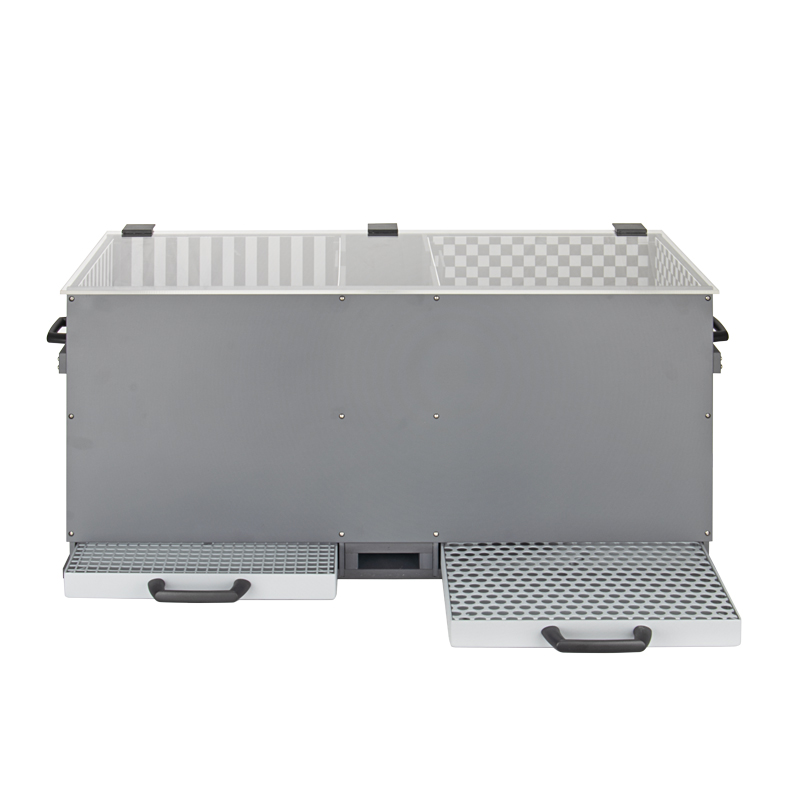
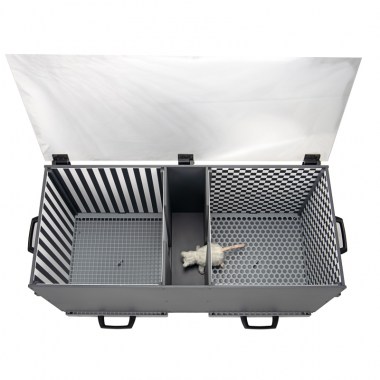
Ugo Basile offers a 3-compartment version of the Conditioned Place Preference (CPP) system for mice, providing researchers with maximum flexibility for evaluating the abuse potential of substances and the motivational effects of drugs. The three-compartment model includes a neutral central chamber, which is ideal as a starting point for unbiased testing. All models are fully optimized for use with video-tracking software or visual scoring.

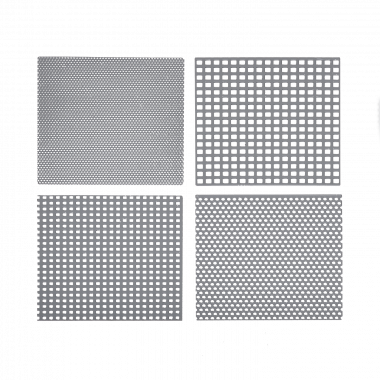
The Conditioned Place Preference system features interchangeable floors optimized for use with video-tracking software or visual scoring, thanks to the grey, high-contrast color and the non-smooth, non-reflective finish.

The system uses interchangeable tactile floors and visual wall patterns to create robust and well-defined contextual cues.

Model
An extended warranty can be added for most Ugo Basile products. You can find this information in the ordering information section of each product.
To learn more about the extended warranty, CLICK HERE

Background

  • The delivery of appetitive and addictive substances (e.g. drugs) or aversive and unpleasant ones in separated cages the animal should retain a memory of, and hence a preference is a classic and relatively simple experiment.
  • Scientists use the rewarding, aversive or even neutral floor and walls differences to create an expectation in the animals that it is in that compartment that they will get more, move more, groom or rear more, etc.
  • Obviously the different walls tend to have a weaker impact than floor texture on the association drug-reward-environment, as rodents have a poor visual sense and it’s normal that changing the floors (e.g. squared of different square size, circular holes, plastic, etc.) will be more effective in inducing a preference for one of the two sides with many potential and highly translational discoveries possible, eg:
    • Evaluate the addictive power of a drug (real or recreational)
    • Evaluate the positive effects of antagonist drugs, which may be real antidotes and save lives (e.g. Naloxone in Heroin overdoses)
    • Much more, including memory and conditioning

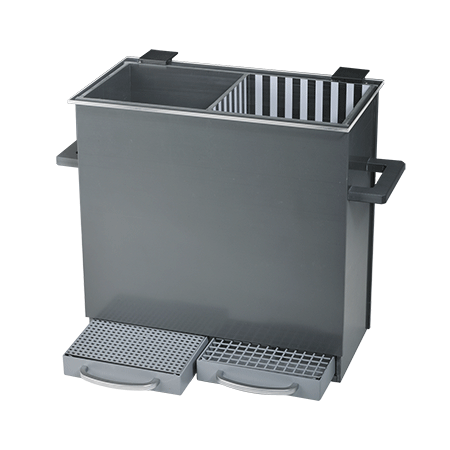
3-Compartment CPP (with Neutral Area)

The three-chamber apparatus adds a central neutral compartment, made of smooth, non-patterned plastic. Two doors connect the neutral area to the lateral conditioning chambers.
The neutral area and the time spent in it represent an additional parameter to be evaluated, which adds complexity to data interpretation.

Customizable, optimized for tracking

  • The box includes the contextual cues required by the experimental paradigm for the customizable compartments:
    • 4 interchangeable floors with square or circular patterns
    • 2 sets of walls, for the 2 experimental chambers
  • Designed and optimized for use with any video-tracking software (such as ANY-maze) or visual scoring.
  • Quick and easy to change both the floors and the wall contexts for a visual and tactile difference between the 2 compartments.
  • On request we can provide customized sets of walls, with different patterns or textures.
  • Works with cabled animals for optogenetics, electrophysiology, miniscopes, etc.


FeatureBenefit

Interchangeable patterned floors and walls

The two compartments differ by tactile stimulation

Walls in either compartment can be altered, by replacing the context kit

The two compartments differ by visual stimulation

High contrast with light or dark animals

Optimized for Video-Tracking

Specific models and floors for rats or mice

Designed for multiple-cage systems for high throughput

Physical

Animal43553 Mouse (3-compartment)

External Dimensions (handles excluded)

45,4 x16,2x32(h)cm

Internal Dimensions (lateral compartments)

16x15x25(h)cm 
Internal Dimensions (central compartment) 5X15x25(h)cm

Patterned Floors

4 interchangeable floors for each cage

Context Walls

2 interchangeable context kits provided with each cage (striped and checkered)

Warranty

Warranty Conditioned Place Preference is covered by a 12-month warranty + 12 after product registration 

The CPP paradigm provides information on the rewarding or aversive effects of visible and tactile contextual cues associated with drugs.
This technique has acquired great popularity in research studies involving addiction, being much easier, if compared to drug self-administration procedures.

First, the animal is conditioned to identify one of the two compartments with the drug experience. Then the time spent in each compartments is measured; preference or
aversion to the drug-paired compartment, hence rewarding/aversive properties of drugs, can be easily deducted.

The CPP test only requires the animal to carry out a simple operation (i.e. move from one compartment to the other) to approach or avoid the drug-paired compartment; the animal is expected to spend more time in the drug-paired compartment, if the drug experience produced a positive effect.

The CPP paradigm provides information on the rewarding or aversive effects of visible and tactile contextual cues associated with drugs.

This technique has acquired great popularity in research studies involving addiction, being much easier, if compared to drug self-administration procedures. First, the animal is conditioned to identify one of the two compartments with the drug experience. Then the time spent in each compartment is measured; preference or aversion to the drug-paired compartment, hence rewarding/aversive properties of drugs, can be easily deducted. The CPP test only requires the animal to carry out a simple operation to approach or avoid the drug-paired compartment; the animal is expected to spend more time in the drug-paired compartment, if the drug experience produced a positive effect.

Ordering information

43553-D03

Mouse Cage for Conditioned Place Preference (CPP), including 4 interchangeable floors and 2 context kits, with central neutral area and 2 doors to access the experimental chambers, for thetered and non-thetered animals

Back to: Behaviour, Conditioning, Reward