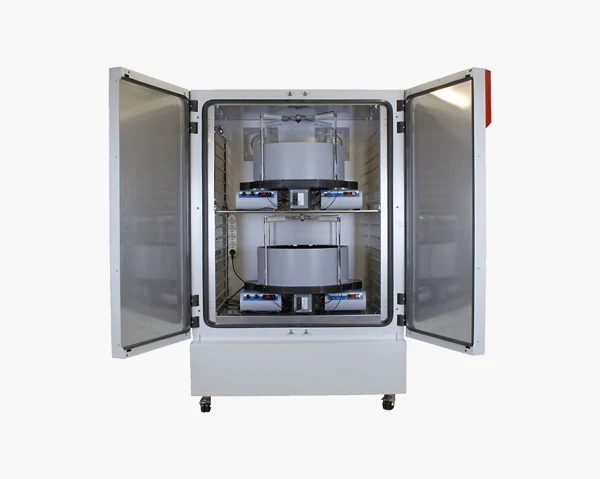


From Observed Fear to Observed Kindness: How Mice Learn Prosocial Behavior by Watching Others
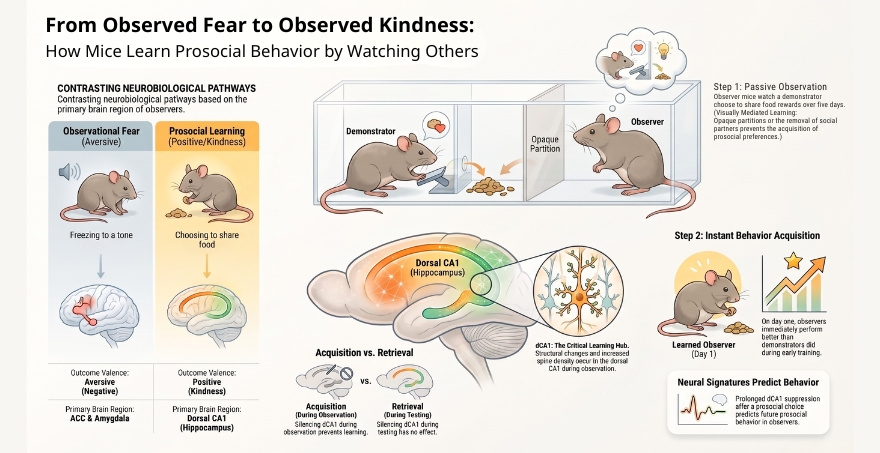
The recent study Individual differences in prosocial learning are represented in the hippocampal dorsal CA1 by La Greca et al. (2026) published in Nature Neuroscience reveals that mice can acquire prosocial decision-making simply by observing others, identifying the dorsal CA1 (dCA1) of the hippocampus as a key neural substrate.
This work builds on a long tradition of observational learning research, historically rooted in fear conditioning paradigms, and highlights how standardized behavioral platforms, such as Fear Conditioning System and 3-Chamber Sociability Apparatus developed by Ugo Basile, continue to enable new scientific discoveries.
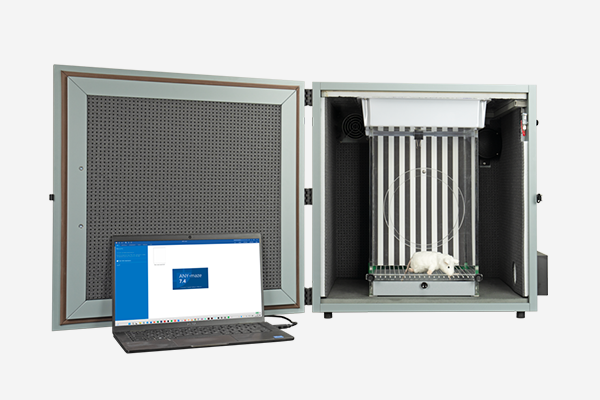
Learn more about Fear Conditioning System by Ugo Basile: https://ugobasile.com/products/categories/behaviour-conditioning-reward/fear-conditioning-system

Learn more about 3-Chambered Social Test: https://ugobasile.com/products/categories/mazes-tracking/sociability-apparatus-for-mice-and-rats-3-chambered-social-test
From Fear to Prosociality: Expanding the Scope of Social Learning
For decades, observational fear conditioning has provided a clear answer to a fundamental question: how do animals learn from others?
In this paradigm, a naïve mouse observes a conspecific receiving a foot-shock paired with a tone and rapidly learns to associate the tone with danger, without direct experience.
But fear represents only one dimension of social learning.
The study Individual differences in prosocial learning are represented in the hippocampal dorsal CA1 by La Greca et al. (2026) shifts the focus toward positive social behaviors, demonstrating that mice can learn to make prosocial choices, such as sharing food rewards, purely through observation .
An Experimental Model of Prosocial Learning
The researchers developed an observational version of a social decision-making (SDM) task, where:
- a demonstrator mouse chooses between a selfish and a prosocial option
- an observer mouse watches without interacting
- after several days, the observer takes control of the task
The outcome is striking:
- observers show immediate task competence
- they display structured decision-making from the first trial
- importantly, they exhibit a bias toward prosocial choices, even when exposed to selfish demonstrators
Control experiments confirmed that learning was:
- visually mediated
- not based on spatial bias
- dependent on the presence of a social partner
The Dorsal CA1: A Neural Substrate for Socially Acquired Knowledge
At the neural level, the study identifies the dorsal CA1 of the hippocampus as essential for acquiring socially transmitted information.
Key findings include:
- increased cFos activation in dCA1
- structural plasticity (higher spine density and maturation)
- causal impairment of learning when dCA1 is silenced during observation
- distinct neural activity patterns predicting future prosocial behavior
Interestingly, dCA1 is required for learning, but not for retrieval, pointing to a highly specific role in encoding observational experience.
Ugo Basile Systems as Enablers of Complex Behavioral Neuroscience
A critical, often overlooked layer of this study lies in the experimental infrastructure.
The authors explicitly report the use of Ugo Basile systems at key stages of the behavioral pipeline, demonstrating how standardized platforms support advanced neuroscience research.Two main tools were used in the experimental pipeline:
Fear Conditioning System Cubicle
The social interaction test, used to characterize the natural interaction between prosocial and selfish observer, was performed inside the sound-attenuating cubicle of the Fear Conditioning System by Ugo Basile
- Function: It served as a platform for a controlled environment, offering insulation from external noise, temperature, and olfactory disturbances.
- Technical Specifications: The cubicle provided uniform and dim lighting (15 lux), which was essential for recording naturalistic social interactions and behavioral tracking without artifacts.
- Methodological Choice: This tool demonstrates how a system originally designed for the canonical observational fear paradigm can be successfully adapted to study its prosocial counterpart.
Learn more about Fear Conditioning System by Ugo Basile: https://ugobasile.com/products/categories/behaviour-conditioning-reward/fear-conditioning-sys
Three-Chamber Sociability Cage
The authors used the Three-Chamber Sociability Cage By Ugo Basile to validate the transfer of learning and ensure the social integrity of the subjects.
- Validation of Learning: It confirmed that the choices made by the observers were not arbitrary but reflected genuine social learning; for example, prosocial observers preferred their original demonstrator over an inanimate object.
- Control of Social Motivation: This apparatus was fundamental to verify that neural manipulations (such as chemogenetic silencing of the dCA1) did not disrupt baseline sociability. This allowed researchers to isolate the learning deficit from any general social motivation effects.
Learn more about 3-Chambered Social Test: https://ugobasile.com/products/categories/mazes-tracking/sociability-apparatus-for-mice-and-rats-3-chambered-social-test
From Experimental Tools to Integrated Research Platforms
This study highlights how modern behavioral neuroscience relies on integrated methodological ecosystems, combining:
- operant paradigms
- controlled environmental systems
- standardized sociability assays
- computational analysis tools (e.g., DeepLabCut, SimBA)
Within this ecosystem, Ugo Basile systems act as foundational infrastructure, enabling reproducibility and experimental precision across different behavioral domains.
Why It Matters
The implications extend beyond basic science.
Disorders such as autism spectrum disorders, schizophrenia or neurodevelopmental conditions are often characterized by impaired ability to learn from others.
Establishing a model of observational prosocial learning opens new opportunities to:
- study underlying neural circuits
- investigate individual variability
- develop targeted therapeutic strategies
Conclusion
This study marks a conceptual shift:
- observational learning is not limited to fear
- it also supports the emergence of prosocial behavior
At the same time, it reinforces a practical truth: cutting-edge neuroscience depends on reliable, flexible, and standardized experimental platforms
The same Ugo Basile systems that have supported decades of fear conditioning research are now enabling the exploration of social cognition, cooperation, and behavioral complexity.