

The Role of the Hargreaves Plantar Test by Ugo Basile in a Model of Prostate Cancer Perineural Invasion
Measuring Thermal Hyperalgesia in Cancer-Associated Neuropathic Pain: The Role of the Hargreaves Plantar Test by Ugo Basile in a Model of Prostate Cancer Perineural Invasion
Cancer-associated pain is a complex and multifactorial condition that often combines inflammatory, neuropathic, and mechanical components. Among the most severe and clinically challenging forms is pain associated with perineural invasion, a pathological process in which tumor cells infiltrate and spread along peripheral nerves. This phenomenon is particularly prevalent in prostate cancer and is strongly correlated with persistent, treatment-resistant pain.
The recent study Tumor–Macrophage–Nerve interactions drive neuroinflammation and neuropathic pain in prostate cancer perineural invasion, published in Brain, Behavior, and Immunity (2026) introduces a well-characterized rat model of prostate cancer perineural invasion and provides new insights into the neuroinflammatory mechanisms driving cancer-induced neuropathic pain. Within this experimental framework, the Hargreaves Plantar Test by Ugo Basile plays a crucial role in the functional assessment of pain, specifically by quantifying thermal hyperalgesia.
Read the complete open access article: 10.1016/j.bbi.2026.106280
Learn more about Hargreaves Plantar Test by Ugo Basile: https://ugobasile.com/products/categories/pain-and-inflammation/plantar-test-for-thermal-stimulation
Perineural invasion as a driver of neuropathic pain
Perineural invasion involves the progressive infiltration of cancer cells into the perineurial and endoneurial compartments of peripheral nerves. In this study, syngeneic prostate cancer cells were microinjected directly into the perineurium of the rat sciatic nerve, allowing the authors to investigate tumor–nerve interactions in a highly controlled and anatomically precise manner.
Over a 21-day period, tumor growth along the nerve was accompanied by:
- robust infiltration of tumor-associated macrophages,
- sustained release of pro-inflammatory cytokines such as IL-1β and TNF-α,
- upregulation of neuronal injury and stress markers (ATF-3, NGF, GDNF),
- hyperactivation of sensory neurons in the dorsal root ganglia (DRG), involving cAMP, p-CREB, and p-ERK1/2 signaling.
Together, these molecular and cellular changes create a neuroinflammatory environment that promotes neuronal hyperexcitability, a hallmark of neuropathic pain.
Why behavioral pain assessment matters
While histological and molecular analyses are essential to understanding underlying mechanisms, pain is ultimately a functional and behavioral phenomenon. Demonstrating that tumor-induced neuroinflammation translates into measurable pain hypersensitivity is therefore critical for validating any preclinical pain model.
To address this, the authors employed a multimodal behavioral assessment strategy, combining:
- von Frey filaments for mechanical allodynia,
- the acetone test for cold allodynia,
- and the Hargreaves Plantar Test by Ugo Basile for thermal hyperalgesia.
This comprehensive approach allowed them to characterize the full sensory phenotype associated with perineural tumor invasion.
The Hargreaves plantar test: assessing thermal hyperalgesia
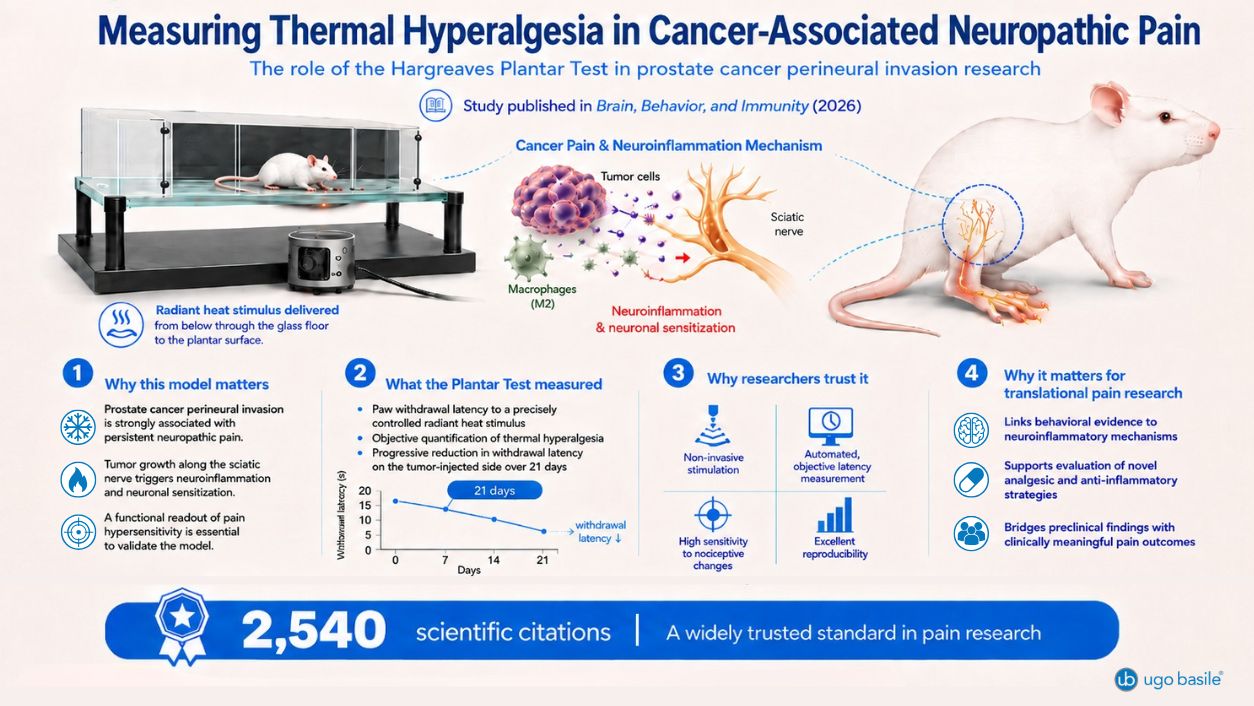
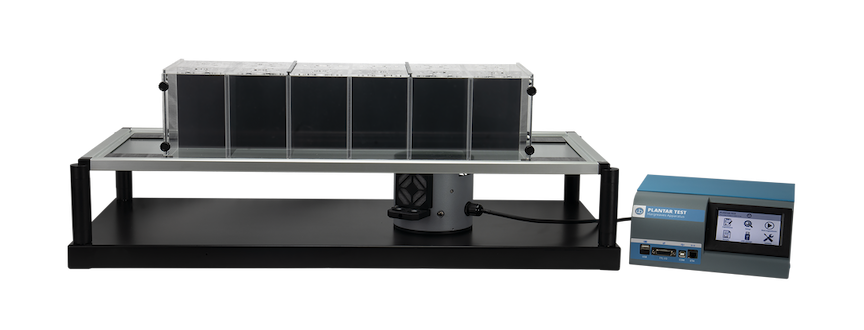
The Hargreaves Plantar Test by Ugo Basile is a gold-standard method for evaluating heat sensitivity in rodents. It measures the paw withdrawal latency in response to a precisely controlled radiant heat stimulus applied to the plantar surface of the hind paw.
Key features of the test include:
- non-invasive stimulation,
- automated and objective latency measurement,
- high sensitivity to changes in nociceptive processing,
- excellent reproducibility across time and experimental groups.
In the prostate cancer perineural invasion model, the Hargreaves test revealed a progressive and significant reduction in withdrawal latency on the tumor-injected side, indicating the development of thermal hyperalgesia. Importantly, this hypersensitivity emerged early and persisted throughout the 21-day observation period, closely paralleling tumor progression and nerve infiltration.
Linking behavior to neuroinflammatory mechanisms
One of the strengths of this study lies in the tight integration between behavioral outcomes and biological mechanisms. The reduction in thermal withdrawal latency measured with the Hargreaves test correlates with:
- elevated levels of pro-inflammatory mediators in the sciatic nerve,
- increased expression of neurotrophic and injury-related factors,
- sustained activation of excitatory signaling pathways in DRG neurons.
In this context, thermal hyperalgesia is not an isolated behavioral finding, but rather the functional manifestation of tumor-driven neuroinflammation and neuronal sensitization.
Further supporting this interpretation, pharmacological inhibition of the MEK/ERK pathway significantly attenuated mechanical hypersensitivity, underscoring the causal link between intracellular signaling, neuronal excitability, and pain behavior.
Relevance for translational pain research
The use of the Hargreaves Plantar Test by Ugo Basile in this study significantly strengthens the translational value of the model. Thermal hyperalgesia is a clinically relevant symptom in cancer-related neuropathic pain, and its reliable quantification in preclinical models is essential for:
- comparing results across studies and disease models,
- evaluating the efficacy of novel analgesic or anti-inflammatory interventions,
- bridging mechanistic research with clinically meaningful outcomes.
By combining standardized behavioral assays with in-depth molecular analyses, this work provides a robust framework for studying cancer-induced neuropathic pain and for testing targeted therapeutic strategies.
Conclusion
In the context of prostate cancer perineural invasion, the Hargreaves Plantar Test by Ugo Basile serves as a critical tool for objectively quantifying thermal hyperalgesia and validating the presence of neuropathic pain. Its use in this study:
- confirms that tumor–nerve interactions lead to functional pain hypersensitivity,
- links behavioral outcomes to neuroinflammatory and neuronal signaling mechanisms,
- and reinforces the reliability and translational relevance of the experimental model.
As cancer pain research continues to evolve, standardized and sensitive behavioral assays such as the Hargreaves test remain indispensable for transforming complex biological insights into meaningful advances in pain management.