

From Ink Footprints to AI: The Evolution of Rodent Gait Analysis
Walking may look like a simple behavior, but it is one of the most informative readouts available to neuroscientists. Every step depends on the coordinated activity of spinal circuits, sensory feedback, brain motor centers and the musculoskeletal system. A lesion, a degenerative process or a painful condition anywhere along this chain can leave a measurable signature in the way an animal walks: a shorter stride, a wider base of support, reduced weight bearing on an injured paw, or a loss of coordination between limbs. The challenge has always been how to capture that signature accurately, objectively and efficiently.
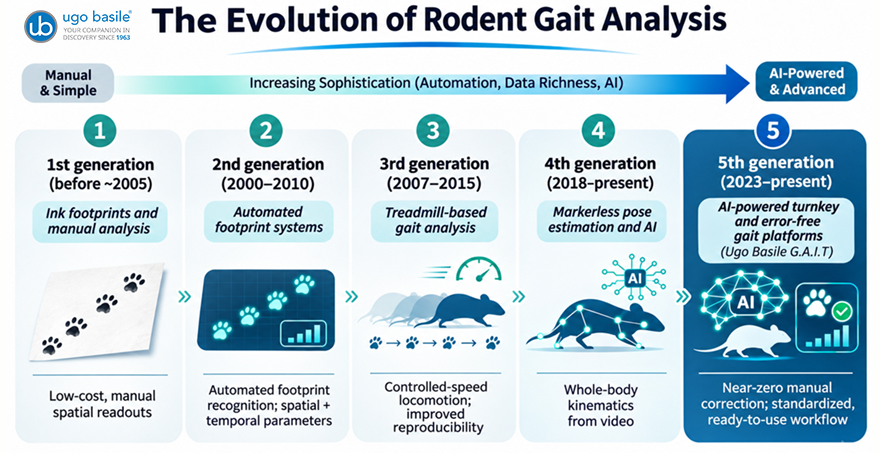
The answer to this challenge has changed considerably over time, reflecting a broader transformation in preclinical research: the need to move from manual, operator-dependent assessments toward more objective, reproducible and automated methods. Over the past 20 years, five major technological generations can be identified:
- 1st generation (before ~2005): ink footprints and manual analysis
- 2nd generation (2000–present): automated footprint systems (e.g. Noldus CatWalk)
- 3rd generation (2007–present): treadmill-based gait analysis (e.g. Mouse Specifics DigiGait)
- 4th generation (2018–present): markerless pose estimation and AI (e.g. DeepLabCut)
- 5th generation (2023–present): AI-powered turnkey and error-free gait platforms (e.g. Ugo Basile GA.I.T)
Inserire immagine
Each generation solved some of the problems of the previous one, and each introduced new questions. Let's walk through them.
1st generation: ink footprints and manual analysis
The earliest gait analysis methods were based on a very simple concept: painting the paws of the animal with ink and allowing it to walk along a paper-covered corridor. Once the run was complete, the sheet of paper became a permanent record of where each paw had touched the ground.
Researchers then measured the footprints manually, typically extracting a small set of spatial parameters:
- Stride length: the distance between consecutive prints of the same paw
- Base width: the distance between left and right paws, an indicator of balance and postural stability
- Paw overlap: how closely the hind paw lands on the print previously left by the ipsilateral front paw
- Hind-to-fore distance: the spatial relationship between hind and front paw placement
Advantages. The approach was extremely inexpensive and easy to implement: paper, ink and a simple corridor were all that was needed. This explains why it has been widely used in models of spinal cord injury, peripheral nerve injury and Parkinsonian disorders, among others, and why, for budget reasons, many laboratories still use it today.
Limitations. The method is labor intensive and low throughput, since every print has to be measured by hand. Its sensitivity is limited, so subtle alterations can easily go unnoticed. Most importantly, it provides no temporal measurements: a footprint shows where the paw touched the ground, but not when, or for how long. Parameters such as swing time, stance time or duty cycle are simply out of reach, and so is any information on how the gait cycle unfolds over time.
2nd generation: automated footprint systems
Noldus Information Technology CatWalk
The introduction of the CatWalk system represented a major leap forward. The key innovation was a glass walkway illuminated using the principle of Frustrated Total Internal Reflection (FTIR). Light travels inside the glass plate, trapped by total internal reflection; when a paw touches the surface, the reflection is disrupted and light escapes at the point of contact, making the paw print glow. A camera placed below the walkway records these illuminated paw contacts as digital video, and software performs automated footprint recognition.
For the first time, researchers could move beyond static prints and quantify both spatial and temporal gait parameters, including:
- Swing duration: the time the paw spends in the air between two contacts
- Stance duration: the time the paw spends in contact with the floor
- Duty cycle: stance duration expressed as a percentage of the whole step cycle
- Print area: the surface of the paw in contact with the floor, often related to weight bearing
- Interlimb coordination: the temporal relationship and stepping pattern between the four limbs
Impact. For the first time, gait analysis became quantitative, reproducible and high throughput. CatWalk became the most widely published rodent gait platform and remains one of the most cited systems today.
Limitations. Automated paw identification is not error free: when animals display atypical locomotion or severe impairment, paws can be misclassified, and these mistakes must be reviewed and corrected manually. This makes analysis time consuming and introduces operator-dependent variability.
A second limitation is related to speed. On the walkway, animals choose their own speed. Because gait parameters depend strongly on walking speed, runs performed at different velocities are difficult to compare, and many runs must be discarded to obtain a consistent dataset.
3rd generation: treadmill-based gait analysis
Mouse Specifics DigiGait
The speed problem led researchers to look for a way to standardize locomotion velocity. DigiGait introduced a transparent motorized treadmill combined with a ventral high-speed camera: the paws are filmed from below while the animal walks at a controlled, predefined speed.
Key advance. Instead of analyzing voluntary walking, the treadmill imposes the speed, so every animal can be tested under identical conditions. This improved reproducibility, the detection of subtle motor deficits and the feasibility of longitudinal studies, in which the same animals are followed over time as a disease progresses or a treatment takes effect. Controlled speed also makes it possible to test animals at different, predefined velocities, which can reveal deficits that only emerge under more demanding locomotor conditions.
This approach proved especially useful in models of Parkinson's disease, ALS, muscular dystrophy and stroke, where small and progressive changes in motor function are precisely what researchers need to detect.
Limitations. Treadmill-based analysis did not eliminate every issue. Paw identification errors can still occur and require time-consuming manual correction. Because locomotion is forced, the resulting gait is less natural and may not fully reflect the animal's spontaneous walking behavior. In addition, the system is extremely bulky, requiring considerable space in the laboratory.
4th generation: markerless pose estimation and AI
DeepLabCut
The deep learning revolution transformed behavioral neuroscience, and gait analysis was no exception. Instead of detecting footprints, researchers began tracking body parts directly from video.
DeepLabCut introduced three key concepts: deep neural networks, markerless tracking (no physical markers need to be attached to the animal) and user-defined body landmarks. The researcher labels the points of interest, such as paws, joints, snout or tail base, on a set of video frames; the network learns from these examples and then tracks the same landmarks automatically in new recordings.
This made it possible to measure:
- Joint angles
- Limb trajectories
- Spine curvature
- Tail movement
- Whole-body kinematics
Impact. Gait analysis expanded beyond footprints into full biomechanics. Questions that were previously out of reach, such as how a joint flexes during the swing phase or how the trunk compensates for a weak limb, could now be addressed quantitatively. The approach spread rapidly because it is open source, highly flexible and extremely accurate.
Limitations. This flexibility comes at a price. DeepLabCut requires advanced IT know-how for installation and use of the open-source tools, programming expertise, adequate computational resources, manual labelling of training frames and model training. Since each laboratory defines its own landmarks and trains its own models, standardization between laboratories remains challenging. For many groups, this creates a barrier between the potential of AI and its practical use in everyday experimental workflows.
5th generation: AI-powered turnkey gait platforms
The newest trend in rodent gait analysis combines deep-learning algorithms, automated paw recognition, dedicated hardware and plug-and-play workflows in a single, ready-to-use system.
The objective is clear: to provide DeepLabCut-level intelligence with CatWalk-level simplicity, reducing manual corrections virtually to zero and delivering standardized outputs that can be compared across experiments and laboratories.
In these platforms, AI is used not only for tracking, but also for:
- Paw classification: correctly assigning every contact to the right limb
- Digit-by-digit classification: identifying individual digits and measuring detailed paw parameters
- Automatic quality control: checking the validity of the data without manual inspection
- Automated stride extraction: identifying gait cycles and events automatically
Ugo Basile GA.I.T
GA.I.T Analysis by Ugo Basile belongs to this new generation. It combines spontaneous locomotion recording, AI-trained paw and body-part detection, automated run selection and dedicated gait parameters in a compact tabletop system.
Recording spontaneous locomotion preserves the natural walking behavior of the animal, while AI addresses the step that has slowed down gait analysis since the first automated systems: paw identification. GA.I.T provides AI paw detection with near-100% accuracy, virtually eliminating manual corrections, and goes down to single-digit detection. Simultaneous ventral and lateral views capture both paw placement and body posture in the same run.
In practice, the workflow is designed to be as linear as possible:
- Record: the animal walks spontaneously while ventral and lateral views are acquired simultaneously
- Detect: AI identifies and classifies each paw and individual digits
- Select and check: valid runs are selected automatically and undergo automatic quality control
- Extract: strides and gait events are identified automatically
- Analyze: standardized gait parameters are generated, ready for statistical analysis
The system is delivered as a plug-and-play bundle with pre-installed PC, camera and software, so laboratories can benefit from AI-based analysis without programming, model training or dedicated IT support. The result is a faster, more reproducible workflow in which researchers spend their time interpreting data rather than correcting it.
Choosing the right approach today
Every generation described here is still in use. Ink footprints remain an option for pilot studies or laboratories with very limited budgets, as long as researchers accept the absence of temporal data and the time required for manual measurement. Treadmill-based systems remain relevant when a strictly controlled speed is essential to the experimental design. Open-source pose estimation tools are a powerful choice for groups with in-house computational expertise that need custom kinematic measurements.
For laboratories that need reliable, standardized gait data from spontaneous locomotion, without investing time in manual corrections, programming or model training, AI-powered platforms such as GA.I.T offer the most direct route from recording to results.
Conclusion
The history of rodent gait analysis can be summarized as a progression through a series of scientific questions:
|
Era |
Main question |
|
1st generation - Footprint era |
“Where did the paw touch?” |
|
2nd and 3rd generation - Automated footprint and treadmill-based gait analysis systems |
“How does the paw move through the gait cycle?” |
|
4th generation - markerless pose estimation and AI |
“How does the entire body move?” |
|
5th generation - automatic and virtually error-free gait analysis with Ugo Basile GA.I.T |
“Can we measure all of this automatically and reliably?” |
The overall trajectory has been from manual footprints → automated footprints → controlled locomotion → markerless biomechanics → AI-assisted automated phenotyping, with increasing accuracy, throughput and biological insight at each step.
Today, the key question is no longer only “where did the paw touch?” or “how does the paw move?”, but rather: can we measure gait automatically, reliably and reproducibly, while reducing the time researchers spend on manual analysis?
With GA.I.T Analysis, Ugo Basile brings AI-powered gait analysis into a complete, accessible and ready-to-use platform for modern preclinical research.
At a glance: five generations of rodent gait analysis
|
Generation |
Technology |
Locomotion |
Main outputs |
Manual effort |
Strengths |
Limitations |
|
1st Ink Footprints |
Ink on paws, paper-covered corridor, manual measurement |
Spontaneous |
Spatial only: stride length, base width, paw overlap, hind-to-fore distance |
Very high |
Extremely inexpensive; easy to implement |
Low throughput; limited sensitivity; no temporal data |
|
2nd generation Automated footprint systems |
FTIR-illuminated glass walkway, digital video, automated footprint recognition |
Spontaneous (animal chooses speed) |
Spatial + temporal: swing, stance, duty cycle, print area, interlimb coordination |
Medium–high (manual paw ID corrections) |
Quantitative; reproducible; high throughput; most published platform |
Paw identification errors; speed-dependent parameters, many runs discarded |
|
3rd generation |
Transparent motorized treadmill, ventral high-speed camera |
Forced, controlled speed |
Spatial + temporal parameters at standardized speed |
Medium–high (manual paw ID corrections) |
Identical test conditions; subtle deficits; longitudinal studies |
Less natural gait; paw identification errors; extremely bulky |
|
4th generation |
Deep neural networks, markerless tracking of user-defined landmarks |
Any (depends on setup) |
Joint angles, limb trajectories, spine curvature, tail movement, whole-body kinematics |
High (labelling, model training, programming) |
Open source; highly flexible; extremely accurate |
IT and programming expertise; computing resources; poor inter-lab standardization |
|
5th generation |
Deep learning + dedicated hardware; AI paw and digit recognition; simultaneous ventral and lateral views |
Spontaneous |
Standardized gait parameters, paw and digit-level parameters, automated stride extraction |
Virtually zero corrections |
Plug-and-play; near-100% paw detection; automatic QC; standardized outputs |
Newest approach; published evidence base still growing |