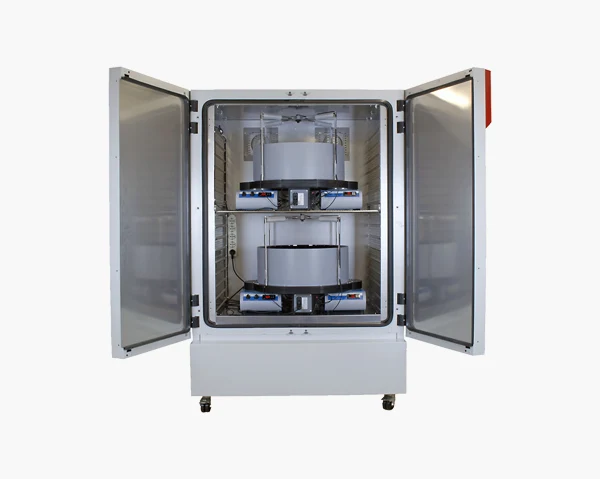


Exploring Thermal Preference: Thermal Gradient Ring (TGR) Literature Review is now available

What is the Ugo Basile Thermal Gradient Ring (TGR)?
Traditional temperature-preference setups, such as linear corridors or two-plate choices, often present significant limitations: animals tend to cluster in corners, spatial confounds skew the results and testing options are restricted.
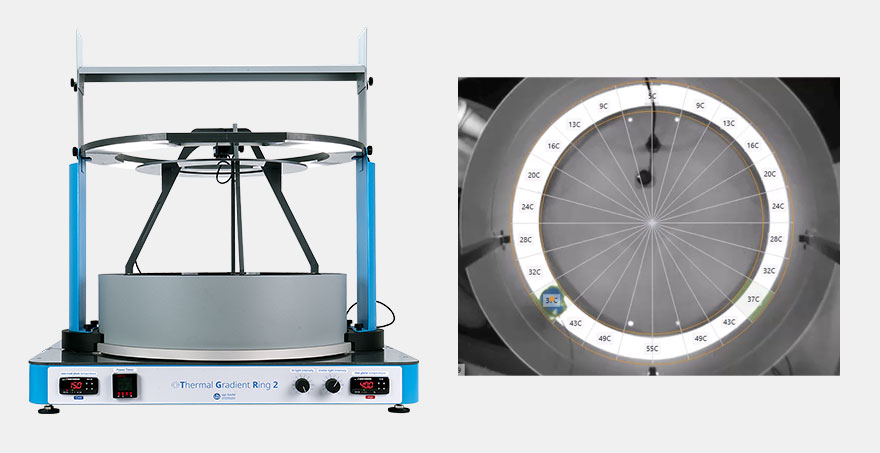
The Ugo Basile Thermal Gradient Ring (TGR - Zimmermann’s method) overcomes these challenges through an innovative circular design. Key features include:
- Corner-free circular track: Mice move freely around a continuous ring, entirely eliminating edge artifacts and stereotypical corner-staying behaviors.
- Duplicated thermal gradient: The ring is symmetrically divided into 12 distinct thermal zones in duplicate (featuring heating and cooling elements on opposite sides), offering high thermal resolution and duplicated values for robust data validation.
- Automated video-tracking & multi-parameter readouts: Powered by specialized ANY-maze protocols and an overhead infrared/visible camera setup, the system automatically tracks animals without direct experimenter intervention. Beyond simple time spent (zone occupancy), it captures travel distance, moving speed, acceleration, zone entries, and automatically calculates the weighted preferred temperature.
- Now ready for cabled animals: The TGR 2.0 features a specialized design supporting swivel mechanisms and unobstructed movement for tethered setups, empowering advanced techniques like optogenetics and electrophysiology.
Learn more about Thermal Gradient Ring by Ugo Basile: https://ugobasile.com/products/categories/pain-and-inflammation/new-thermal-gradient-ring-tgr-zimmermann-s-method-2-0
From methodological validation to 2026 Frontiers
The scientific framework underlying this approach is rooted in foundational methodological studies on the circular gradient (such as the pioneering work by Touska et al., 2016), which demonstrated the advantages of this design over traditional tests. Building upon these solid principles, Ugo Basile engineered the TGR platform, whose applications have expanded significantly over the years:
- TRP channels and thermosensation & the Tominaga Lab contribution: This field is strongly anchored by landmark mechanistic studies from world-renowned authorities in thermosensation, most notably the laboratory of Prof. Makoto Tominaga. Key publications from his team (such as Ujisawa et al., 2022 and 2024, alongside Lei et al., 2023) have been crucial in demonstrating how multi-parametric analysis (evaluating moving speed, acceleration, and temporal dynamics alongside time spent) unlocks complex phenotypes associated with TRPM8, TRPA1, TRPV1, and TRPV3.
- Neuropathy and neurodegenerative diseases: From diabetic peripheral neuropathies (Sasajima et al., 2022) to Parkinson's models (Valek et al., 2021; Franck et al., 2026) and work published in Nature (Hakim et al., 2025), the system has successfully detected early sensory dysfunctions before overt structural axonal loss occurs.
- 2026 updates in pain and pharmacology: The updated edition places strong emphasis on recent breakthroughs in experimenter-free pharmacological pain assessment, highlighted by Garcia et al. (Pain Reports, 2026), which applies functional linear models for advanced drug testing.
- Metabolism and thermogenesis: Another fast-growing application area uses this paradigm as a non-invasive behavioral window to monitor thermogenic state and energy expenditure (De Melo et al., 2025; Sankina et al., 2024).
Why the TGR outperforms conventional thermal tests
While traditional hot/cold plate tests or Hargreaves assays measure acute evoked responses at fixed temperatures, the circular gradient approach evaluates spontaneous thermal preference and avoidance within a continuous environment, minimizing spatial confounds.
The Ugo Basile TGR translates this solid scientific philosophy into advanced instrumentation, seamlessly integrating thermal data with the locomotor and temporal profiles of the rodent.
Want to explore all the references and discover how to integrate the TGR into your upcoming experimental protocols?
Download TGR Literature Review